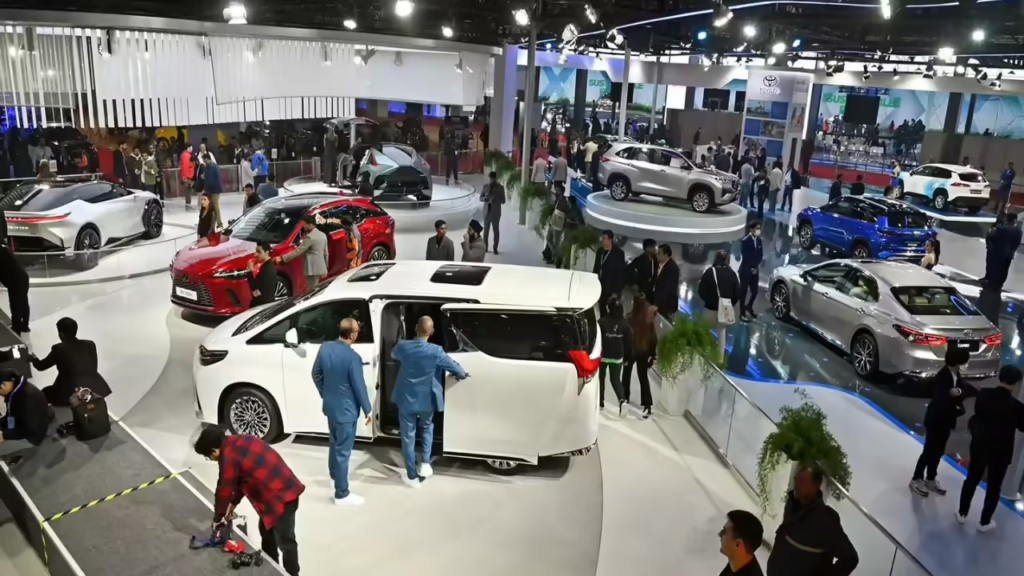
The Indian automotive landscape has officially shifted into high gear as it enters the 2026-27 fiscal year. The opening month of April has set a staggering precedent, characterized by record-breaking sales volumes, a flurry of high-profile launches across both the luxury and electric segments, and strategic manufacturing pivots that signal a long-term bullish outlook for the world’s third-largest auto market.

The Sales Titan: Maruti Suzuki’s Historic April
The headline of the month belongs undeniably to Maruti Suzuki. The industry leader didn’t just meet expectations; it shattered them by recording a historic 239,646 units sold in April 2026. This represents a phenomenal 33% growth compared to the previous year, solidifying its dominant market share. This surge indicates a robust appetite in the entry-level and mid-range segments, suggesting that consumer confidence remains at an all-time high.

However, the spotlight isn’t shared by Maruti alone. The battle for the second and third spots has intensified into a high-stakes rivalry between Tata Motors and Mahindra & Mahindra. Both domestic giants reported strong growth in the Passenger Vehicle (PV) segment. While Mahindra continues to leverage its “SUV-only” brand strength, Tata Motors is seeing consistent demand driven by its multi-powertrain strategy (Petrol, Diesel, CNG, and EV). This “close race” is fostering rapid innovation as both brands vie for the loyalty of the modern Indian car buyer.
Luxury and Innovation: From BMW to Oben
April proved that the Indian market is as diverse as it is large. On one end of the spectrum, the luxury segment welcomed the BMW M440i Convertible, priced at Rs 1.09 crore. This launch caters to a growing demographic of enthusiasts seeking performance-oriented open-top motoring, signaling that the premium lifestyle segment is thriving.
Conversely, the two-wheeler electric segment saw a major disruption with Oben Electric’s launch of the Rorr EVO. Priced aggressively at Rs 99,999, the bike offers a substantial 180km range, positioning it as a direct threat to traditional internal combustion engine (ICE) commuters. Furthermore, the excitement continues to build as Lexus prepares to debut its new three-row electric SUV on May 6, 2026, which will likely set a new benchmark for sustainable luxury.
Strategic Manufacturing: Toyota and Renault’s Big Moves
The manufacturing sector is witnessing a massive infusion of capital and structural change. Toyota has announced a landmark plan to build three new assembly plants in Maharashtra. This move is expected to significantly boost their production capacity for both domestic and export markets, further cementing Maharashtra’s status as India’s primary automotive hub.
Meanwhile, Renault is taking a more structural approach to its Indian operations. The company has moved the National Company Law Tribunal (NCLT) to facilitate a restructuring process. The focus here is on separating its powertrain operations and boosting its export capabilities. This maneuver is part of a global strategy to become more agile in an era where engine technologies are rapidly evolving.
Policy Shifts: Simplifying Ownership and Fueling the Future
On the regulatory front, the Indian government is contemplating two major shifts that could redefine vehicle ownership and technology:
- Inter-State Transfer Simplification: Discussions are underway to remove NOC (No Objection Certificate) requirements for inter-state vehicle transfers. This would be a massive relief for owners and could significantly boost the organized used-car market.
- The E85 Push: The government is encouraging manufacturers to upgrade their technology to support E85 fuel (85% ethanol blend). This move aims to reduce the country’s dependency on oil imports and promote a “Flex-Fuel” ecosystem.
The EV Revolution: A 70% Jump
The most telling statistic of the year so far is the performance of Electric Vehicles (EVs). Between January and April 2026, EV sales jumped nearly 70%. While mass-market adoption is growing, there is a notable spike in the premium EV segment. As charging infrastructure expands across national highways, the initial “range anxiety” is being replaced by “performance desire,” with Lexus and BMW leading the charge in the high-end space.
Conclusion
As we move into May, the momentum shows no signs of slowing down. With Toyota scaling up production, the government simplifying ownership laws, and brands like Maruti and Tata pushing sales to new heights, India’s auto sector is not just recovering—it is reinventing itself for a high-tech, sustainable future.